HPE 747595-001 Riser Card Hp
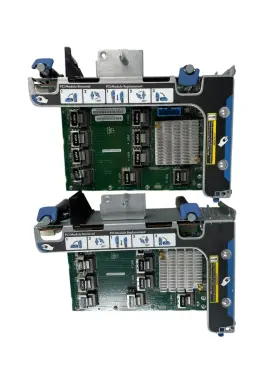
( Brand: Hpe ), ( Type: Card ), ( Unit Type: Unit ), ( Product Type: Server Accessories ), ( Manufacturer Part Number: 747595-001 ), ( Country Of Origin: China )
Review HPE Lot Of Hp Riser Card
The HP 747595-001 Riser Card is a high-performance expansion solution designed for HP ProLiant DL380p Gen10 servers. This riser card provides an additional PCIe slot, enabling users to install additional PCIe devices such as network adapters, storage controllers, or GPUs to enhance the server's functionality and capabilities.
The HP 747595-001 Riser Card is engineered with robust components that ensure reliable operation in enterprise-class environments. It supports PCIe Gen3 x8 devices, offering ample bandwidth for high-speed data transfer. Additionally, it is designed with a hot-plug capability, allowing users to install, remove, or replace devices without powering down the server, minimizing downtime and maximizing efficiency.
The riser card is installed in the rear expansion bay of the DL380p Gen10 server, providing easy access to the PCIe slot. It also includes a locking mechanism to securely hold the device in place, preventing accidental removal and ensuring stability during operation.
The HP 747595-001 Riser Card is backed by HP's comprehensive support and warranty services, providing peace of mind and ensuring that any issues are addressed promptly and effectively. With its high-performance capabilities, hot-plug design, and robust construction, the HP 747595-001 Riser Card is an excellent investment for businesses seeking to maximize the potential of their HP ProLiant DL380p Gen10 servers.
The HP 747595-001 Thunderbolt 3 Riser Card is a device designed to add expansion capabilities to a Thunderbolt 3-enabled system. Here are some potential pros and cons of buying this riser card:
Pros:1. Additional Expansion: The HP Thunderbolt 3 Riser Card provides an additional expansion slot for peripherals, enabling users to connect more devices to their system without cluttering up the limited number of available ports.
2. Versatile Connectivity: The riser card supports various types of peripherals, including external graphics cards, docks, and storage devices.
3. Compact Design: The compact design of the HP Thunderbolt 3 Riser Card allows users to keep their cables neatly organized and reduces the risk of accidental damage due to cable tangling.
4. Easy Installation: Installing the riser card is relatively straightforward, as it simply plugs into an available Thunderbolt 3 port and can be mounted using the included VESA bracket.
5. Power Delivery: The riser card supports power delivery, allowing it to supply power to connected devices, such as external graphics cards or high-powered storage devices.
Cons:1. Cost: The HP Thunderbolt 3 Riser Card can be quite expensive compared to other expansion options, such as USB hubs or PCIe expansion cards.
2. Limited Compatibility: The riser card may not be compatible with all systems, especially older or non-Thunderbolt 3-enabled systems.
3. Additional Complexity: Adding a riser card to a system can add an additional layer of complexity, as users need to ensure that their system and the connected peripherals are compatible and properly configured.
In conclusion, the HP Thunderbolt 3 Riser Card offers several advantages, including additional expansion capabilities, versatile connectivity, a compact design, easy installation, and power delivery. However, it also comes with some disadvantages, such as cost, limited compatibility, and additional complexity.
If you have a Thunderbolt 3-enabled system and require additional expansion capabilities, the HP Thunderbolt 3 Riser Card could be a worthwhile investment. However, if you're on a tight budget or don't need the specific features offered by the riser card, other expansion options, such as USB hubs or PCIe expansion cards, may be more suitable for your needs. Ultimately, the decision to purchase the HP Thunderbolt 3 Riser Card depends on your system configuration, peripheral requirements, and budget.
Details:
GOOD, LOT OF 3.
part #: 747595001 prices
- $19.00-$22.88
specifications serversappy:
- brand: Hpe
- type: Card
- unit type: Unit
- product type: Server Accessories
- manufacturer part number: 747595-001
- country of origin: China
general serversappy:
- condition: Used
- Enterprise Networking, Servers > Server Components > Other Ent Server Components
offer serversappy:
- options: Ship-to-home
- availability: In Stock
- quantity: 1
- started: October 23, 2025
- sold: 0
returns serversappy:
- policy: No Returns
seller serversappy:
- city: Atlanta, Georgia
- rating: 97.8%
- # reviews: 1944
payments serversappy:
- wallet: Apple-pay
- credit card: Mastercard
- other
shipping serversappy:
- class: Standard
- cost: $11.49
- transit: 5-11 Days
- service: USPS Ground Advantage
- type: Calculated
- carrier: USPS
Hpe 747595-001 Is Similar To:
- Hp 871820-001 Hpe Dl380 G10 Primary Pci Riser Cage 875056-001 (40.8% similar) Hpe pic-e cage and riser card also had two M.2 slots on the board...(July 23rd, 2024)
- Hpe 449416-001 Lot Of 3 Hp Memory Expansion Board (67.4% similar) Enhance your servers performance with this lot of 3 hp 449416-001 memory expansion boards. These memory expansion boards are perfect for those who require high-performance computing and server components. Designed to fit perfectly in your enterprise-level networking and server components, these...(July 24th, 2024)
- Hp 875087-001 Hpe Pci Riser Quad Slim Sas Board (52.4% similar) Sold as is, has not been tested, tested...(July 24th, 2024)
- Hpe hp P01466-001 867113-002 P01466-001 867113-002 Proliant Dl380 Gen10 G10 Plastic Air Baffle Lot 2 (21.9% similar) Testing cosmetic notes: this is a used working item in very good cosmetic condition that was pulled from a environment and guaranteed working, pulled from working hp pliant DL380 GEN10 2u servers. Only what is photoed included. Server components...(September 11th, 2024)
- Hpe 3par 729689-001 Lot Of 13 Blank Hdd (57.9% similar) Lot of 13 729689-001 blank HDD. Included with listing: this listing only includes what is shown in the main image above. Item is defective. Any other parts, accessories, power adapters, etc. Are not included unless indicated below. Device is are in great condition. If you want...(September 12th, 2024)
- Hp 875780-b21 Hpe Dl38x Gen 10 2x8 Pcie Tertiary Riser (26.4% similar) Quality new and refurbished it parts with up to 80% off the Rep. Components stated within the listing will always take precedence over what is shown in image. Inventory shipped within 60 minutes to anywhere in the Teri state. Trade in purchase program for decommissioned equipment...(September 23rd, 2024)
- Hp P52459-001 Primary Riser Cage For Hpe Proliant Dl325 G11 (43.8% similar) A top rated it hardware supplier. Every hardware purchase includes a free 30 day maintenance warranty...(September 24th, 2024)
- Hpe 670759-b25 Lot Of 2 Mellanox Infiniband 3m Fdr Qsfp Dac Cable 674852-001 (40.7% similar) Could have marker writing on unit. Has clearly been used. The item exteriors may have minor scratches, scuffs, dents, cracks, nicks, etc. This item was pulled from a working machine and is guaranteed. No manuals, cords, cables, batteries, battery charger, external power supply, software...(September 24th, 2024)
- Hpe Kbn 924 101002 Qty 2 Hp 700138-002 32gb Sdhc Mirco Sd Card (42.4% similar) ...(September 30th, 2024)
- Hpe Kbn 924 100987 Qty 2 Hp 649871-001 331t 1g 4port Ethernet Card (42.7% similar) Qty 2 hp 649871-001 331T 1g 4 port Ethernet card, 60 day warranty, free fed ex or USPS ground shipping card warranty...(September 30th, 2024)
- Hp P20155-001 Hpe Dl325 Pri X16x16 Riser (46.8% similar) Part #: hp P20155-001 for sale...(October 30th, 2024)

3 offers $19.00–$22.88 USD
- Used. Offer #1 priced at $19.99 + $0.00 delivery = $19.99* total. ITEM TYPE RASER KIT FOR DL380 G9. INCLUDED 1x RISER.FREE SHIPPING
- Used. Offer #2 priced at $19.00 + $0.00 delivery = $19.00* total. Condition- Used / Tested & 100% Working.FREE SHIPPING
- Used. Offer #3 priced at $22.88 + $0.00 delivery = $22.88* total. FREE SHIPPING